Downloads use this browser’s storage. The browser may remove them when space is low. Check readiness before setting out. Stop diagram, not street navigation.
Save one route and its audio in your chosen language on this device. Not ready offline: Games require an internet connection.
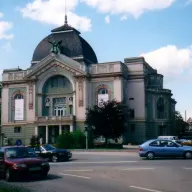
Theater Gera.
The theatre was built between 1900 and 1902 to designs by the architect Heinrich Seeling. It is regarded as one of the finest Art Nouveau theatres in Thuringia.
Gera had grown rich from its textile industry, and this splendid building shows the city's confidence. Drama, opera, ballet, concerts and puppet theatre are still staged here today.
Look for: The curving lines and ornaments of the façade – classic Art Nouveau.
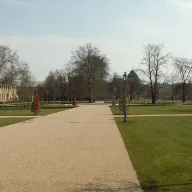
Orangery & Küchengarten.
The Küchengarten was laid out in 1729 as a Baroque pleasure garden on a French model. The orangery with its curved semicircle followed in 1729–1732.
Orangeries sheltered delicate plants such as citrus trees through the winter. Today the Gera art collection shows paintings and prints here.
Look for: The symmetry of the semicircle – best seen from the middle of the garden.
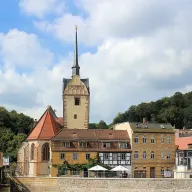
St Mary's Church, Untermhaus.
The late Gothic church dates from around 1440. Inside it keeps a precious altar from the 15th century.
Together with the bridge over the White Elster it forms the most photographed view of Gera.
In 1736, the church became the parish church for Untermhaus, Gries and Cuba. From 1802 to 1854, it also served as a garrison church for the Reuss military.
Look for: Walk a few steps to the bridge – that is where the famous view is.
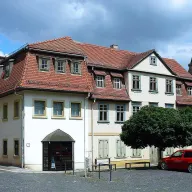
Otto Dix House.
Otto Dix was born in this house in Untermhaus in 1891. He became one of the most important German painters of the 20th century.
His birthplace is now a museum dedicated to the artist's life and work.
A museum and gallery complex opened here on 2 December 1991 to mark the artist’s 100th birthday. The historic domestic setting illustrates everyday life in a modest working-class household around 1900.
Look for: The Elster riverbank close by – the landscape Dix saw as a child.
Osterstein Castle.
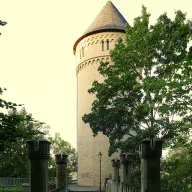
The residence of the ruling family once stood on the Hainberg. On 6 April 1945 the castle was largely destroyed, and the remains were demolished in 1962.
The keep survived and is now a lookout tower over Untermhaus and the Elster valley.
Look for: The view down over Untermhaus and the Elster.
Hofwiesen Park.
The park on the White Elster was redesigned for the 2007 Federal Garden Show, which Gera hosted together with Ronneburg.
Today it is a favourite place for walks, sport and family outings right in the city.
Look for: The paths along the White Elster.
City Museum.
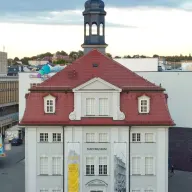
The building was put up between 1724 and 1738 as a workhouse and orphanage.
After a full restoration the City Museum reopened in 2005 and tells the story of Gera.
Look for: The strict Baroque façade – built for order, not for show.
Town Pharmacy.
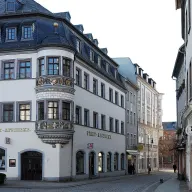
The Town Pharmacy was built in 1592 and is Gera's second surviving Renaissance building.
Its jewel is the richly decorated oriel window of 1606.
The building has been used as a pharmacy since 1847. Beneath it are two Höhler cellars dating from 1712, whose steady coolness once helped preserve tinctures, cod-liver oil and juices.
Look for: The oriel: the projecting window on the façade.
Samson Fountain.
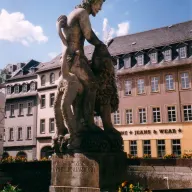
The sculptor Caspar Junghans created the fountain in 1685. It shows the biblical hero Samson and is the centrepiece of the market square.
The original was replaced by a copy in 1979.
For almost 140 years, the fountain initially stood in a corner of the market square and supplied water for drinking and everyday use. Only later was it moved to the centre of the square.
Look for: Take a close look at the figure on top of the fountain.
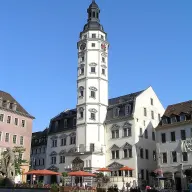
Town Hall.
The town hall was built in Renaissance style in 1573–1575 and is a landmark of the city.
A historic measuring standard survives on the richly decorated main portal, so traders and customers could check lengths at the market.
Until the early 20th century, a watchman lived in the town hall tower to raise the alarm in case of fire. A manually played carillon has sounded from the tower lantern since 1988.
Look for: Find the old measure on the portal.
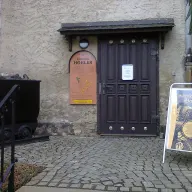
Gera Höhler cellars.
Beneath the old town lies a second Gera: cellars dug into the rock, called Höhler.
Citizens with brewing rights kept their beer cool down here. Some Höhler can be visited on guided tours – the entrance to the museum cellars is on Steinweg, at the corner of Geithes Passage.
Look for: The modest entrances – the underworld begins behind them.
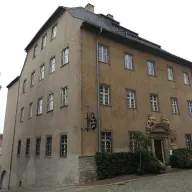
Schreiber House.
It is the only house in the old town that survived the great fire of 1780 undamaged.
It is named after the Schreiber family, who lived here from 1716 to 1847. Today it houses the Museum of Natural History.
The present house was built in 1686–1688 on the remains of a predecessor destroyed by fire. Studies of the roof timbers confirm this construction period; the Baroque hall on the second floor dates from the same time.
Look for: Imagine: everything around burned – except this house.
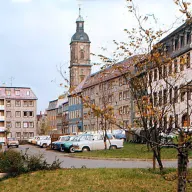
St Salvator's Church.
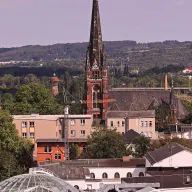
The Baroque church was built in 1717–1720 on the Nicolaiberg, the highest point of the old town.
Inside it holds a surprise: the interior was designed in Art Nouveau style.
Look for: Baroque outside, Art Nouveau inside.
St John's Church.
The old St John's Church on Johannisplatz burned out in the great fire of 1780. The new church, the largest in Gera, was designed by Constantin Lipsius and August Hartel and paid for mainly by donations from local people. It was consecrated on 18 September 1885 – exactly 105 years after the fire.
In April 1945 bombs destroyed its roof and windows; it was restored between 1972 and 1975. In autumn 1989 the peace prayers began here, and from them grew Gera's demonstrations of the Peaceful Revolution. Inside plays a Kreutzbach organ from 1885 with 57 stops.
Look for: Red brick and a tower rising 70 metres into the sky.
Haus Schulenburg.
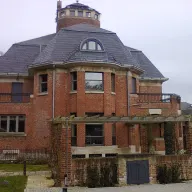
The Belgian artist and architect Henry van de Velde built the villa in 1913/14 for the textile manufacturer Paul Schulenburg – house, interiors and garden all by one hand. Van de Velde is regarded as a pioneer of the Bauhaus.
In 1946 the family was expropriated, and the house later became a medical college. Since 1997 it has been lovingly restored. Today it is a museum with Europe's largest collection of van de Velde's book designs. In the garden stands the "Crouching Girl" by Richard Engelmann.
Look for: House and garden form one total work of art – look at the calm, flowing shapes.
Botanical Garden.
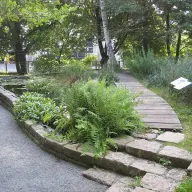
Gera’s Botanical Garden was founded in 1864 as a public garden outside the old town wall. The city has since grown around it; today this green retreat covers about 0.7 hectares near the centre.
Two springs, a late-Classical tower house and a sequence of habitats—from dry grassland to wet meadow—make the compact garden a small lesson in Thuringian nature. Follow the paths and look for the changes in soil and moisture.
Tinz Palace.
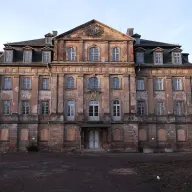
The foundation stone of Tinz Palace was laid in 1745, and the Baroque residence was completed in 1748. It rose on the site of a medieval moated castle or manor belonging to the Tinz estate.
Over the centuries the palace served as a summer residence, a widow’s seat, a hospital and a centre for adult education. Today it is part of the Gera-Eisenach Cooperative State University campus. Notice the balanced façade and central projection—hallmarks of its Baroque design.
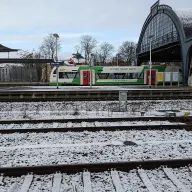
Gera Central Station.
The railway reached Gera in 1859, when the first station was built on this site. The present reception building followed in 1881, and by 1911 a glass train shed had made the station a key stop on the Berlin–Leipzig–Munich route.
War and the division of Germany changed the network and reduced Gera’s role as a railway junction. Today the station is a gateway to the city and a regional transport hub. From here, tram, theatre, Küchengarten and the old town are all close by.
Gera Town Wall.
Fragments of Gera’s medieval town wall survive among the buildings of the old town. The stones are easy to miss: the wall has become part of later streets, courtyards and houses rather than a separate monument.
Pause at the exposed section near Nicolaistraße. It offers a glimpse of the boundary that once protected the settlement and helps explain the narrow lanes and changing levels around the historic centre.
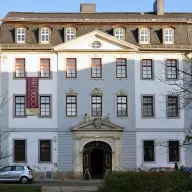
Ferber House · Museum of Applied Arts.
Behind the Baroque façade of Ferber House, the Museum of Applied Arts explores how design shapes everyday life. The building is one of Gera’s notable historic town houses and gives the collection an atmospheric setting.
The museum presents decorative arts, fashion, furniture and objects ranging from Art déco and Bauhaus ceramics to design from the GDR era. Look up at the façade details, then imagine the contrast between the historic rooms and the modern objects inside.
The permanent exhibition focuses on the years between the two world wars. Its highlights include photographs by Aenne Biermann and works by the architect and designer Thilo Schoder.
Hof and Chamber Estate.
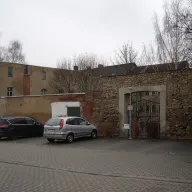
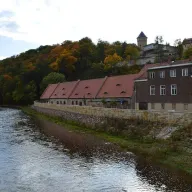
Below Schloss Osterstein, Count Heinrich XVIII Reuß-Gera commissioned a large estate in 1728. Known as the Kammergut or Hofgut, it supplied and administered the princely household.
The complex joined an administrative residence with a washhouse, barns, storage buildings and coach houses. The old estate buildings still reveal their working purpose in their sturdy forms and courtyards. Look back uphill to see how closely the estate and the former residence were connected.
The architect Melchior Brenner designed the estate as a trapezoidal complex. The former washhouse was enlarged in 1859/60 and given a neo-Gothic stepped gable that echoed the alterations to the palace at that time.
Historic Market Square.
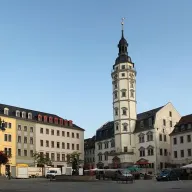
Gera’s market square has been the civic heart of the city for centuries. The Renaissance town hall, built from 1573 to 1575, anchors the square beside the richly decorated city pharmacy and the Simson Fountain.
Look closely at the town hall’s ornate portal and the mix of façades around the square. The square is still a place to meet, shop and celebrate—so the historic centre remains part of everyday city life.